
Fundador da WIC
Companhia Neerlandesa das Índias Ocidentais (em holandês: West-Indische Compagnie ou WIC) fundada a 2 de Junho 1621.
Livros sobre Espagíria / Alquimia:

Edição do século XVII da Tábua de esmeralda, livro chave da alquimia ocidental
"O que eu disse da Obra Solar é completo!"

Outros autores:
Los espagiristas vallisoletanos de la segunda mitad del siglo XVI y primera mitad del siglo XVII

The publication of the Twelve Years' Truce at Antwerp City Hall, by Michiel Collijn.
Twelve Years' Truce declared in Antwerp in 1609. Town square with town hall. Crowd. Trumpet players. Illumination using tar barrels. Horses. Dogs. Wheelbarrow. Latin text: Componunt pacem REX, et SACER ORDO beatam Annis bis senis, utinam DEUS ille Deorum Aeterno Belgis concedat foedere pacem, Hoc precor illa dies velox affulgeat orbi.

The capture of Kochi and victory of the Dutch V.O.C. over the Portuguese in 1663, on the coast of Mallabar.
in Wikipedia: A Guerra Luso-Holandesa, foi um conflito armado entre tropas portuguesas, contra as forças holandesas da Companhia Holandesa das Índias Orientais ou VOC e da Companhia Holandesa das Índias Ocidentais ou WIC, que haviam ocupado territórios ultramarinos portugueses durante o domínio espanhol da coroa portuguesa, tais invasões ocorreram principalmente no Nordeste do Brasil e o litoral de Angola, ocorreu inicialmente no âmbito da resistência local, e mais tarde no que se denominou de Guerra da Restauração, tais confrontos armados, entraram para os anais da História, como o primeiro grande conflito à escala mundial.

 Reprodução de aguarela realizada em Goa entre 1893 e '95
527. [s. d.: séc. XVII]
Regimento [extracto do] que o capitão-geral de Ceilão, D. Jerónimo de Azevedo, deu a um capitão que enviou à fortaleza de Galle.
(Regimentos, Instruções e Resoluções pertencentes à Índia e mais conquistas, principalmente do tempo do vice-rei de Portugal D. Pedro de Castilho, séc. XVI-XVII, fl. 294)
Cod. 51-VII-11
910. [1612-1617]
“Respostas que da Dom Jeronimo de Azevedo Visorey 1612-1617, que foi das Jndias Orientais aos 23 cargos a que lhe mandaraõ Responder, Vai trasladado o cargo e logo a Resposta, e no fim dellas se Responde ao Jntroito dos cargos”
(Miscelânea Ultramarina, n.º 18, fls. 146-186)
Cod. 51-VII-27
937. 1613 Janeiro 25, Lisboa
Carta régia de [D. Filipe II], ao vice-rei da Índia, [D. Jerónimo de Azevedo], pela qual ordena se dê o apoio de que necessitar Belchior Rodrigues, capitão da caravela “N. Sr.ª dos Remédios”.
(Regimentos, Instruções e Resoluções pertencentes à Índia e mais conquistas, principalmente do tempo do vice-rei de Portugal D. Pedro de Castilho, séc. XVI-XVII, n.º 48, fl. 159)
Cod. 51-VII-11
940. 1613 Fevereiro 16, Madrid
Carta do marquês de Castelo-Rodrigo, Cristóvão de Moura, ao [bispo de Leiria], vice-rei [de Portugal, D. Pedro de Castilho], sobre Henrique de Montford, francês, que de Portugal foi à Índia por terra, e de lá veio preso para o Limoeiro, por ordem do vice-rei D. Jerónimo de Azevedo, e depois foi solto a instância dos reis de França, o qual reclama os diamantes que trazia consigo.
(Do Governo de Portugal. Cartas do marquês de Castel-Rodrigo para o bispo D. Pedro de Castilho, inquisidor-geral e presidente do Paço, n.º 37, fl. 75)
Cod. 51-VIII-14
950. 1613 Maio 25, Lisboa
Carta do [vice-rei de Portugal], bispo de Leiria, D. Pedro de Castilho, [ao meirinho-mor, conde de Sabugal, D. Francisco de Castelo Branco], sobre a devassa do vice-rei da Índia, D. Jerónimo de Azevedo, e o descaminho das fazendas das naus da Índia.
(Do Governo de Portugal. Cartas do conde de Sabugal para o bispo D. Pedro de Castilho vice-rei e presidente do Paço; e as respostas do bispo, n.º 29, fls. 45-46)
Cod. 51-VIII-15
951. 1613 Maio 28, Madrid
Carta do meirinho-mor, conde [de Sabugal, D. Francisco de Castelo Branco], [ao vice-rei de Portugal, bispo D. Pedro de Castilho], sobre a devassa do vice-rei da Índia D. Jerónimo de Azevedo, que tira Fernão Cabral.
(Do Governo de Portugal. Cartas do conde de Sabugal para o bispo D. Pedro de Castilho vice-rei e presidente do Paço; e as respostas do bispo, n.os 161 e 162)
Cod. 51-VIII-15

Dois Documentos Manuscritos a analisar:
http://objdigital.bn.br/acervo_digital/div_manuscritos/mss1312886_87/mss1312887_130.pdf

Joannes Leo Africanus (Wikipedia)
(/ˌæfrɪˈkeɪnəs/; born al-Hasan ibn Muhammad al-Wazzan al-Fasi, Arabic: حسن ابن محمد الوزان الفاسي; c. 1494 – c. 1554).

Contributeur : Temporal, Jean (15..-157.? ; libraire). Traducteur

Hugo Grotius Ontsnapt in een Boekenkist uit Slot Loevenstein
Hugo Grotius escapes in a book chest from Castle Loevenstein.
Painting by Johannes Hinderikus Egenberger (Museum: Amsterdam Museum)
Ver ficha de Elsje van Houweningen:
https://nenu1621.blogspot.com/search?q=groot
A rever:

Hugo Grotius reunido com quatro homens - quem são?
(Alamy - This image is a public domain image, which means either that copyright has expired in the image or the copyright holder has waived their copyright. Alamy charges you a fee for access to the high resolution copy of the image.

Jacob Proeningh van Deventer 1577-/1642
Jacob was in 1621 kapitein en kommandant van Loevenstein en is daardoor in de geschiedenis bekend geworden, omdat het onder zijn kommandement was, dat Hugo de Groot in een koffer uit het slot Loevenstein ontvluchtte.

Não consegui ainda confirmar a fonte segura da data da morte: 1642
É estranho, que quatro anos depois morre no mesmo castelo Rombout Hogerbeets (1561-1625) e ainda não encontrei referencias a Jacob Proeningh van D.

Hein was born in Delfshaven (now part of Rotterdam), the son of a sea captain, and he became a sailor while he was still a teenager. In his twenties, he was captured by the Spanish, and served as a galley slave for about four years, probably between 1598 and 1602, when he was traded for Spanish prisoners. Between 1603 and 1607 he was again held captive by the Spanish, when captured near Cuba.
In 1607, he joined the Dutch East India Company and left for Asia, returning with the rank of captain (of the Hollandia) five years later. He married Anneke Claesdochter de Reus and settled in Rotterdam. In 1618, when he was captain of the Neptunus, both he and his ship were pressed into service by Venice. In 1621 he left his vessel behind and traveled overland to the Netherlands. For a year in 1622 he was a member of the local government of Rotterdam, although he didn't even have citizenship of this city: the cousin of his wife, one of the three burgomasters, made this possible.
In 1623, he became vice-admiral of the new Dutch West India Company (WIC) and sailed to the West Indies the following year. In Brazil, he briefly captured the Portuguese settlement of Salvador, personally leading the assault on the sea fortress of that town. In August with a small and undermanned fleet he sailed for the African west coast and attacked a Portuguese fleet in the strongly defended bay of Luanda but failed to capture any ships. He then crossed the Atlantic ocean again to try and capture merchant ships at the city of Vitória, but was defeated by a resistance organized by the local citizenry with the assistance of the Portuguese garrison. After finding that Salvador had been recaptured by a large Spanish-Portuguese fleet Hein returned home. The Dutch West India Company, pleased with Hein's leadership qualities, placed him in command of a new squadron in 1626. In subsequent raids during 1627 at Salvador, he attacked and captured over thirty richly laden Portuguese merchant ships before returning to the United Provinces.
Modern historians today often classify Hein as a pirate, though he was more properly a privateer; the Dutch Republic was locked in mortal combat with the Habsburgs and Hein was among the most successful and famous commanders it employed during the Eighty Years' War. While many privateers behaved no better than common pirates, Hein was a strict disciplinarian who discouraged unruly conduct among his crews and had rather enlightened views for the times about "Indian" tribes, slaves and members of other religions. Also, he never was an individual privateer but rather commanded entire fleets of warships.
Spanish treasure fleet
Main article: http://en.wikipedia.org/wiki/Battle_in_the_Bay_of_Matanzas
In 1628, Admiral Hein, with Witte de With as his flag captain, sailed out to capture a Spanish treasure fleet loaded with silver from their American colonies and the Philippines. With him was Admiral Hendrick Lonck and he was later joined by a squadron of Vice-Admiral Joost Banckert, as well as by the pirate Moses Cohen Henriques. Part of the Spanish fleet in Venezuela had been warned because a Dutch cabin boy had lost his way on Blanquilla and was captured, betraying the plan, but the other half from Mexico continued its voyage, unaware of the threat. Sixteen Spanish ships were intercepted; one galleon was taken after a surprise encounter during the night, nine smaller merchants were talked into a surrender; two small ships were taken at sea fleeing, four fleeing galleons were trapped on the Cuban coast in the Bay of Matanzas.
After some musket volleys from Dutch sloops the crews of the galleons also surrendered and Hein captured 11,509,524 guilders of booty in gold, silver, and other expensive trade goods, such as indigo and cochineal, without any bloodshed. The Dutch didn't take prisoners: they gave the Spanish crews ample supplies for a march to Havana. The released were surprised to hear the admiral personally giving them directions in fluent Spanish; Hein after all was well acquainted with the region as he had been confined to it during his internment after 1603. The capture of the treasure fleet was the company's greatest victory in the Caribbean.
As a result, the money funded the Dutch army for eight months (and as a direct consequence, allowing it to capture the fortress 's Hertogenbosch), and the shareholders enjoyed a cash dividend of 50% for that year. Hein returned to the Netherlands in 1629, where he was hailed as a hero. Watching the crowds cheering him as he stood on the balcony of the town hall of Leyden he remarked to the burgomaster: "Now they praise me because I gained riches without the least danger; but earlier when I risked my life in full combat they didn't even know I existed...". Hein was the first and the last to capture such a large part of a Spanish "silver fleet" from America.
Lieutenant-Admiral
He became, after a conflict with the WIC about policy and payment, Lieutenant-Admiral of Holland and West Frisia on 26 March 1629, and thus factual supreme commander of the confederate Dutch fleet, taking as flag captain Maarten Tromp. He died the same year, in a campaign against the Dunkirkers, the highly effective fleet of Habsburg commerce raiders and privateers operating from Dunkirk. As it happened his flotilla intercepted three privateers from Ostend. He deliberately moved his flagship in between two enemy ships to give them both simultaneous broadsides. After half an hour he was hit in the left shoulder by a cannonball and was killed instantly. He is buried in the Oude Kerk in Delft.
Commemoration
The Piet Hein Tunnel in Amsterdam is named in his honor, as is the former Dutch Kortenaer class frigate, Hr. Ms. Piet Heyn.
A direct descendant of Hein was Piet Hein, a famous 20th century Danish mathematician, physicist and poet.
A song praising Admiral Hein's capture of the Spanish "silver fleet" written in 1844 is still sung by choirs and children at primary school in the Netherlands.


Hendrick Corneliszoon Lonck (Roosendaal, 1568 — Amsterdã, 10 de outubro de 1634) foi um militar, administrador colonial e herói naval neerlandês.
Tranferiu-se para Amsterdã em 1604, trabalhando como skipper, armador e comerciante.
Em 1628, junto a Piet Heyn e a serviço da Companhia Neerlandesa das Índias Ocidentais (WIC) como almirante, capturou a frota espanhola da prata.[1]
Substitui Piet Heyn, em 1629, como general-capitão, após Heyn ter se demitido da WIC (West-Indische Compagnie).
Em 1630, com uma frota de sessenta e sete navios, conquistou uma parte do Brasil (Olinda e Recife).[2]
Após seu retorno à República Neerlandesa, em 20 de julho de 1630, também demitiu-se da WIC.
Faleceu em 10 de outubro de 1634 e foi sepultado na Oude Kerk em Amsterdã.



As datas para esta personagem não estão fechadas. A de nascimento aponta para 1585, pois tinha 28 anos no 1613... há referências à morte de Antoine de La Sallete em 1626 (decapitado a mando de Mulay Zidan), mas a tendência está em que só pode morrer depois de 1629... máximo até '37.

Faca de bolo atribuida ao comandante Appolonius Scott.
Informação recolhida no leilão https://www.icollector.com/Ornate-silver-cake-knife-from-wedding-of-Dutch-VOC-fleet-commander-Apollonius-Scott-in-Indonesia_i9882035
Foi vendida por 720 dólares em 2010.
Auction Location: Winter Park, Florida, USA
Ornate silver cake knife from wedding of Dutch (VOC) fleet commander Apollonius Scott in Indonesia, early 1600s, with framed reproduction of the 1753 inheritance letter of William Browne of Salem, Mass.
The knife 38.5 grams and 7-1/2" long; frame 12" x 15".
When is the last time you saw a single utensil mentioned specifically in a will? That is how important this heirloom must have been to the Browne family, and examining the piece will show you why: The ornate, hollow, rectangular handle is completely covered in engraved decorations depicting various wedding couples and family trees, etc. with Latin wording interspersed, the narrow sides with APOLLONIVS + SCOTT (curiously misspelled, who, as the letter says, was "the Father... of said Bishop Burnett's Lady") and "Erst fien end dan betrachten" ("first consider the end"?), hallmarks B.G, head, lion and D on the blade, the silver worn but with all its details clear.
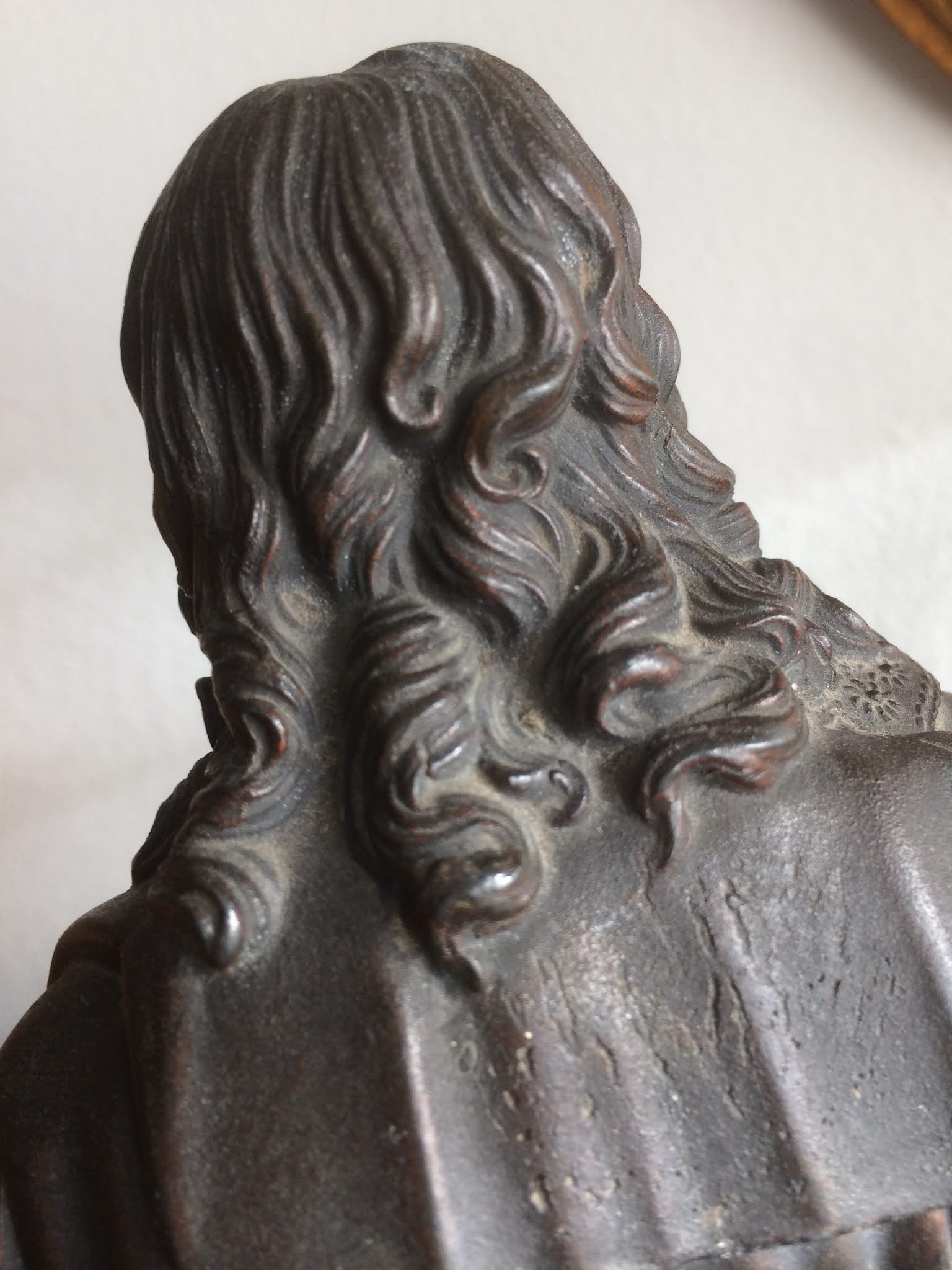
 Busto de Jean-Baptiste Théodon representando Kristina Wasa (Cristina Vasa 1626 - 1689) - Rainha da Suécia durante dezanove anos, de 1633 a 1654. A escultura foi fotografada no National Museum de Stockholm a 5 de Junho de 2009, data dos primeiros contactos com a história desta rainha, lutherana por nascimento, abdicou do trono para se converter ao catolicismo, amiga e admiradora de René Descartes e do Padre António Vieira, estudante de alquimia em Roma e grande patrona das artes.
Une médaillon en bronze représente le profil de la souveraine. Fille unique du roi Gustave Adolphe, chef des armées protestantes pendant la Guerre de Trente Ans, Christine de Suède sera élue reine à l'âge de quatre ans, après la mort de son père à la bataille de Lützen. Son règne effectif, qui commencera en 1644, sera marqué à ses débuts par dans les négociations du traité de Westphalie. Parlant français, allemand, italien et latin aussi bien que suédois, elle recevra à sa cour de nombreux savants, philosophes et artistes, parmi lesquels Descartes. Le mode de vie et la liberté d'expression de la reine ne seront pas du goût des protestants luthériens, la religion officielle du pays. Opposée au mariage, malgré une liaison avec comte Magnus de la Gardie, Christine s'opposera à la noblesse suédoise soucieuse des intérêts nationaux en fréquentant les jésuites. Elle renoncera au trône au profit de son cousin Charles Gustave, prétextant que le trône était un fardeau trop lourd pour une femme, et se convertira au catholicisme. Elle quittera sa Suède natale le jour du couronnement de Charles Gustave, en juin 1654. Habillée en homme, voyageant avec une suite réduite de douze personnes, elle traversera l'Allemagne et la Hollande protestantes, et parviendra en août dans les Pays-Bas espagnols, premier pays catholique de son itinéraire, où elle sera reçue par l'archiduc Léopold. Son séjour de onze mois à Anvers et à Bruxelles lui vaudra la réputation de la femme lesbienne, libertine et scandaleuse. Elle débarquera à Rome en en novembre 1655. Le nouveau Pape Alexandre VII lui déroulera le tapis rouge. Le collège des cardinaux, qui l'attendait à la porte de la ville, l'accompagnera avec la noblesse romaine jusqu'à la basilique de Saint-Pierre, où elle se prosternera devant l'autel. Pour l'Eglise, la conversion d'un personnage aussi important représentait une victoire sur l'hérésie protestante. Le jour de Noël, elle retournera à Saint-Pierre pour faire sa première communion qu'elle recevra des mains du pape. Ce dernier l'invitera à dîner le lendemain, honneur extraordinaire pour une femme, avant qu'elle ne soit escortée en procession au Palais Farnèse, que le duc de Parme avait mis à sa disposition. Le pape et de la curie prendront leurs distances avec celle qui refusera d'adopter les moeurs d'une catholique dévote. Cette reine sans royaume revendiquera alors le trône de Naples. Le royaume des deux Siciles, colonie espagnole, était en rébellion depuis presque une décennie. Le duc de Guise, qui avait pris la tête d'une insurrection soutenue par les Français en 1648, échouera une première fois et sera emprisonné. Il prendra ensuite la tête d'une escadrille navale pour évincer les Espagnols. Sous prétexte que la peste l'empêchait de passer par l'Allemagne, Christine demandera la permission de traverser la France afin de se rendre en Suède, afin d'y régler des affaires financières. Elle sera accueillie, en août 1656, à Lyon par le duc de Guise, avant de se rendre à Paris qui lui consacrera une semaine de cérémonies et de divertissements. Les Français lui proposeront le trône de Naples, à la condition qu'ils puissent récupérer le territoire à sa mort. Mazarin songera d'y installer Philippe d'Anjou, frère de Louis XIV, pour fonder une dynastie Bourbon qui servirait de contrepoids à la puissance de l'Espagne. Trahie par son écuyer Monaldeschi, qui préviendra les Espagnols de son alliance avec les Français, la reine Christine le fera assassiner par trois de ses gardes dans la Galerie des Cerfs. Ce crime lui vaudra le surnom de Sémiramis suédoise. Ecarter du trône de Naples, Christine rentrera en Italie après avoir emprunté d'importantes sommes d'argent à Mazarin. Elle envisagera un instant de revendiquer le trône de Pologne, et finira sa vie à Rome où elle décédera en 1689. Elle est enterrée dans les Saintes-Grottes.

